From pub-cabinet imagery to RNG-driven spins, this guide explains what carries over to online play and what changes.
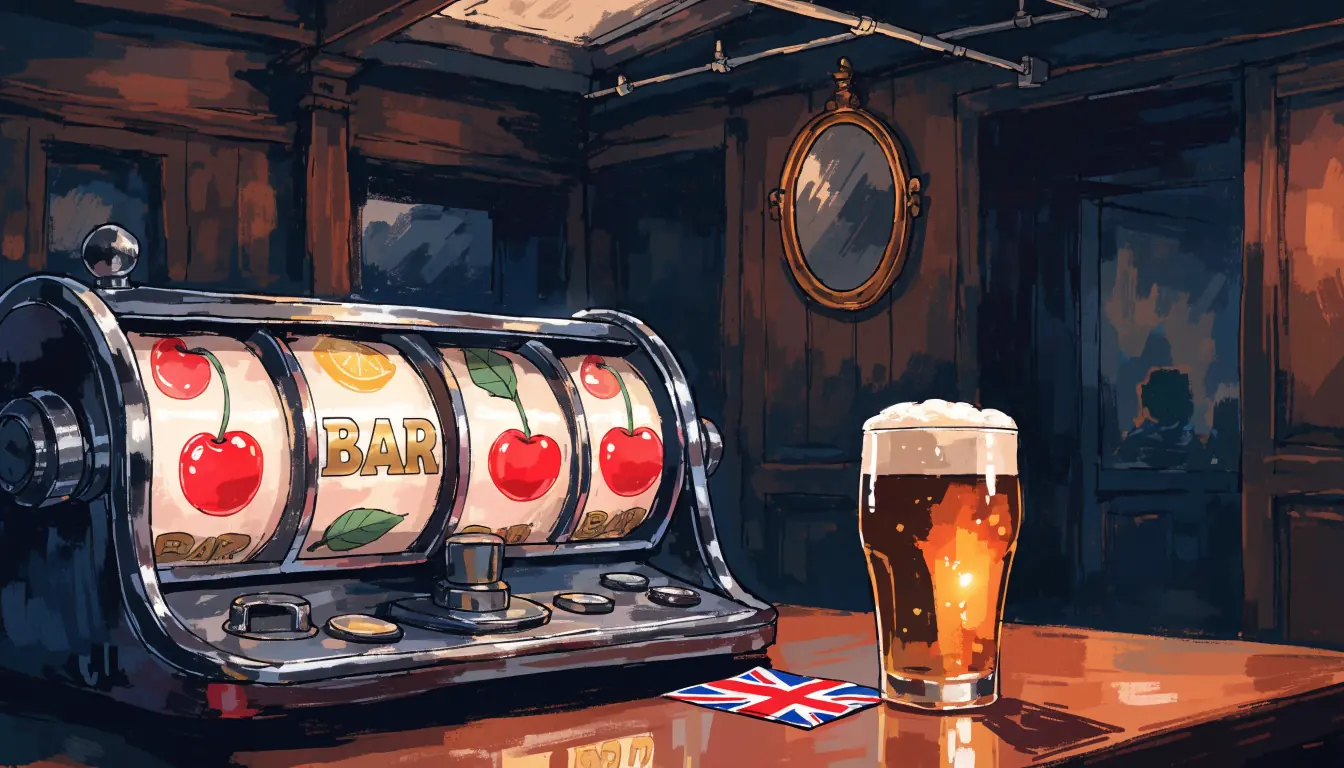
The online fruit machine is a digital descendant of the physical machines found in pubs, arcades and betting shops. Its familiar visual language—bright fruit symbols, bold colours and compact play—helps connect the modern game with the pub fruity. The setting has changed, but the central appeal remains recognisable: a short game built around symbols and a result.
That continuity is mainly about presentation. Online fruit slots can retain the look and atmosphere associated with traditional cabinets while running through software on a computer or mobile device. The screen replaces the physical cabinet, and the game’s presentation is delivered digitally. A familiar theme does not mean that the underlying game works exactly like an older machine, however. Online titles can use modern mechanics alongside imagery that recalls the older format.
The important difference is how outcomes are produced. Online fruit-machine-style games use a random number generator, or RNG, to determine results. Each outcome is independent: a previous spin does not make a particular result more or less due on the next one. The fruit symbols and other graphics show the result on screen; they do not create a sequence that can be read as a forecast.
This distinction matters because visual familiarity can suggest more continuity than is really there. A digital game may resemble a cabinet from a local pub, yet its operation is governed by software rather than by the physical mechanism of a machine. The theme is a link to the past, not evidence that the game follows the same process or that a pattern can be anticipated.
For players looking at fruit machine slots in the UK, the result is a broad category rather than one fixed format. Some online games preserve a deliberately classic appearance; others use the fruit-machine theme as a starting point for a more contemporary presentation. In either case, familiar symbols are part of the design, while the RNG determines each result independently.
The move online therefore changed the medium without removing the recognisable identity of the pub fruity. Its imagery and concise style remain useful shorthand for a particular kind of game, even as digital software supplies the underlying play. The practical way to assess an online title is to separate those two layers: the theme may feel familiar, but each game’s rules and mechanics belong to its own digital design.
Traditional fruit machine games are defined by a simple arrangement: three reels and one payline. The aim is to match symbols along that line, rather than navigate a more elaborate grid. With few extra features to interrupt the spin, the format keeps attention on the symbols and the result they form.
That simplicity is also what distinguishes classic fruit slots from newer designs. A single payline gives each spin one route to a line win; the layout does not offer the many lines or alternative win patterns found in other formats. The basic structure is easy to read, although a simple layout does not make outcomes predictable.
Some classic-style games add holds or nudges. A hold keeps a selected reel in place while the other reels spin again. A nudge moves a reel by one position after a spin, potentially bringing a different symbol into line. These features create a small decision point, but they do not make the result controllable: holds and nudges do not change the random process behind the outcomes.
Their presence and operation depend on the individual game. A title may offer one feature, both, or neither, and any conditions are part of that game’s rules. The paytable or help screen is therefore the place to establish what a button does before play; the label alone is not a complete set of terms.
For players drawn to the familiar pub-fruity format, the appeal is largely mechanical: three reels, one line to follow and few layers between a spin and its result. Holds and nudges add interaction without changing that underlying structure.
Modern fruit-machine games can look familiar while using a more elaborate grid beneath the symbols. A common layout has five reels and three rows, with fixed paylines running across particular positions. A win depends on matching the required symbols along one of those routes, according to the game’s paytable. The number of lines affects how many routes are active on each spin; it does not make every symbol combination a winner.
Routes are set by the game rather than chosen by the player, with the paytable determining which symbol sequences qualify.
Matching symbols connect across adjacent reels instead of following a fixed set of line patterns.
The reel structure varies from spin to spin, potentially generating up to 117,649 ways to win.
Many games use between 10 and 50 fixed paylines. With fixed lines, the routes are set by the game rather than chosen spin by spin. The paytable shows which symbol sequences qualify and what each pays at the selected stake. That makes the grid only part of the calculation: a visually similar line of symbols may have a different result depending on its position and the game’s rules.
Some titles replace conventional paylines with a “243 ways to win” system. Here, matching symbols can connect across adjacent reels rather than needing to land on one of a fixed set of line patterns. The number describes possible winning routes through the reels, not a promise that a spin will produce a win. The game’s paytable still determines which combinations count.
Megaways takes a different approach by changing the number of symbols displayed on each reel from spin to spin. Because the reel structure varies, the possible routes vary too; a Megaways game can generate as many as 117,649 ways to win. That is a maximum number of combinations, not a fixed count available on every spin. The changing grid is the central mechanic, so its symbol arrangement and paytable matter more than a headline figure alone.
These formats alter how wins are formed, not the basic need to understand the game’s rules before staking money. A game description can identify whether it uses fixed paylines, ways to win or a changing-reel system. The paytable then gives the working detail: qualifying combinations, symbol values and any conditions attached to a feature. Comparing those mechanics is more useful than treating a larger route count as evidence of better value.
Rainbow Riches is a useful example of how a fruit-themed slot became part of the UK’s gambling landscape. The franchise began on Barcrest cabinets in 2006, appearing in pubs, arcades and betting shops. Its later move online, around 2009, carried a familiar cabinet title into a different format: a game that could be encountered on a screen rather than only at a physical machine.
That history gives Rainbow Riches a particular place among fruit-themed slot games in the UK. It was not simply an online theme designed to evoke old pub machines; the title had already appeared on cabinets before its online release. The distinction matters when comparing versions, because the physical and digital games are not necessarily configured identically.
The stated online version has a 95% return to player (RTP). Physical Rainbow Riches machines are generally set to pay out at a lower rate. RTP is a long-run theoretical measure, not a forecast of what a particular session will return, and the difference does not make an individual result predictable. It does, however, show why the game’s cabinet history should not be treated as evidence that every version has the same return.
Rainbow Riches therefore links a recognisable UK cabinet past with online play, while also illustrating a practical point about named titles: a shared theme does not establish identical terms across formats. The online figure belongs to the online version, not automatically to every machine carrying the franchise name.
Online fruit slots bring the familiar fruit-machine format to a screen, but the playing experience depends on the individual game. A specialist review describes features that may appear in these titles: free spins within a game, pick-style mini-games, autoplay, quick spin and mobile compatibility. These are options, not a standard package. A particular fruit slot may include some of them and omit others.
That distinction matters when comparing games. A fruit theme on the screen does not tell much about how a title plays. The feature set, pace and interaction can differ, even when the symbols look familiar. The game’s own information and controls provide the clearest indication of what is available in that version.
Free spins can form part of a game’s own feature set, giving a round a different structure from ordinary spins. Their presence does not, by itself, explain what triggers them or how they affect play; those details are specific to the title. The game’s rules should set out the relevant conditions.
Pick-style mini-games add a choice-based stage. A game may present items to select, with the result determined by its rules. The format changes the interaction, but it does not establish that a player can influence the underlying result. The useful comparison is therefore practical: whether the extra stage is engaging or simply adds steps to the game.
Autoplay and quick spin address pace in different ways. Autoplay lets spins proceed without a separate manual start each time, while quick spin shortens the presentation of a spin. Neither feature changes what the game offers in its rules. They change how play is presented and controlled, which can make the session feel materially different.
These settings are not equally suited to every playing style. Manual spins leave a pause between actions; autoplay removes that repeated input, and quick spin compresses the visual sequence. Where such controls appear, they should be treated as pace settings rather than evidence of improved returns. A faster sequence can make a session move more quickly without changing its financial terms.
Mobile compatibility means a fruit slot can be played on a compatible mobile device, rather than being confined to a desktop format. The screen size changes how the game is viewed and controlled. Reels, controls and feature prompts need to remain legible and usable within the device’s display; the actual presentation is title-dependent.
A mobile version should not be assumed to offer a different game simply because it appears on a smaller screen. The relevant details remain those of the specific title: its rules, available features and controls. If a feature is not shown or explained in the version being played, its presence elsewhere should not be presumed.
The practical difference between device formats is mainly in the interface. Touch controls replace a mouse or other desktop input, and the display is arranged for a smaller screen. That can make a compact layout easier to use on a phone, while a larger screen may present more of the game at once. These are format considerations, not indicators of a better outcome.
A useful comparison starts with the features actually present, rather than the number of features a game might support in principle. One title may focus on straightforward spins; another may add a pick stage, free spins or pace controls. Mobile access may matter for someone playing on a phone, while autoplay or quick spin may be irrelevant to someone who prefers to start each spin manually.
The game’s instructions are also part of the playing experience. They explain how its features operate and what conditions apply. A feature name alone is not enough to assess it: the rules determine when it appears and what happens during it. Clear explanations make it easier to distinguish an added interaction from a change in the game’s underlying terms.
There is no single online format that defines every fruit slot. The familiar theme can sit alongside different optional features and interfaces, and their availability varies by game. The sensible comparison is between the actual controls and rules on screen, not assumptions based on a title, theme or device.
A casino offering online fruit machine games to people in the UK must hold a valid licence from the UK Gambling Commission (UKGC). The rule applies to operators targeting UK players regardless of where the company is based. A website’s appearance, game selection or claim that it is “international” does not replace that requirement. For a fruit slots casino in the UK, the relevant test is whether the operator serving the account is licensed for the UK market.
This boundary matters more than the particular style of game on offer. Classic fruit slots and newer fruit-themed titles are still casino games when played for money online. Their familiar symbols do not put them outside gambling regulation, and a large catalogue does not compensate for an operator that lacks the required licence.
A UKGC licence places an operator within the UK regulatory system. That is the basis for the protections and routes for complaint available to customers of licensed casinos. It gives a player a defined regulator and rules against which an operator’s conduct can be assessed. Without that framework, a dispute about an account, a game or a withdrawal becomes harder to resolve through UK channels.
The licence is not a guarantee that every transaction will be free of delay or disagreement. It does, however, distinguish a UK-regulated operator from a site operating beyond the UKGC system. That difference should be settled before a deposit, not after money is tied up in an unresolved account issue.
A UK-facing casino may display licensing information in its footer or terms. The useful detail is the operator’s identity and the status of its UKGC licence, rather than a general badge or a statement that the business is licensed somewhere. A licence from another jurisdiction is not a substitute for the UK licence required to serve UK players. Nor does a game supplier’s licence establish that a particular casino is authorised to operate in Britain.
Offshore casinos without a UKGC licence can be accessible to UK residents, but accessibility does not make them legal UK casinos or place them under UK safeguards. The operator is outside the UK regulatory system. If it delays or refuses a payout, changes access to an account, or disputes the balance, UK protections may not offer a practical route to compel a resolution. The player may have little recourse.
Unlicensed Sites
Offshore casinos without a UKGC licence operate outside the UK regulatory system, meaning players may have no practical recourse if a site refuses a payout or withholds winnings.
There is also a more direct financial risk: an unlicensed site may manipulate games or withhold winnings. A prominent promotion or a wide range of fruit machine games does not reduce that exposure. Large headline offers are packaging; the central cost is that the operator is not answerable under the UKGC framework.
Customers at offshore sites also lose access to protections tied to UK-licensed gambling, including GAMSTOP and IBAS dispute resolution. That is not a minor difference in service. It changes the available options if gambling needs to be blocked across participating operators or if a dispute requires independent resolution. A site cannot provide those UK protections simply by accepting registrations from the country.
Playing at an offshore casino without a UK licence does not make the player liable for a fine or criminal prosecution. That does not make the choice financially safe. The operator’s lack of UK authorisation shifts the practical risk onto the customer: a balance may be difficult to recover, and the protections attached to licensed play may not apply.
The phrase “UK casinos with fruit slots” should therefore describe licensed operators serving the market, not any website that happens to accept a UK registration. The licence is a threshold condition, not a quality score or a ranking. It does not identify the best casino, and it does not establish that a particular game version or feature is available there. Those questions require separate checks.
The order of assessment matters. First establish that the operator holds the relevant UKGC licence. Then consider the casino’s own terms and the specific game information. Reversing that order gives promotions, familiar titles or attractive presentation more weight than the basic question of who is accountable for the account.
An offshore site may appear to offer the same fruit machine games as a licensed casino. The products can look similar while the legal position is materially different. In the UK market, the relevant comparison is not simply which site has the more appealing games; it is whether the operator is authorised to serve UK players and whether UK protections apply if something goes wrong.
For a casino fruit slots search, that distinction is the cost calculation. A UKGC licence does not promise a win or remove ordinary gambling risk. It does establish a regulatory route that an offshore operator without the licence does not provide. No bonus, game selection or “classic” label offsets the loss of that route.
When choosing a UK fruit machine slots site in 2026, payout timing is one practical detail worth checking. This list gives a concise reference point for that information.
WinBeast
WinBeast lists a payout speed of 1–3 business days, a useful detail to consider when reviewing its fruit machine slots offering.
Revery Play
Revery Play lists payouts as taking 1–3 business days. That gives readers a stated timeframe to bear in mind.
NightLuck
NightLuck gives a payout speed of 1–3 business days, providing a straightforward point of reference for players.
SlotoSport
SlotoSport lists a payout speed of 1–3 business days. This is the available practical detail for readers to consider.
Chanze
Chanze states a payout speed of 1–3 business days, which may help readers assess the payment timing information available.
x3bet
x3bet lists payouts as taking 1–3 business days. This gives readers a stated timeframe to keep in mind.
Jetsetspins
Jetsetspins lists a payout speed of 1–3 business days, offering a clear payment-timing detail for consideration.
Dieselwin
Dieselwin gives a payout speed of 1–3 business days. That is the key stated detail available for this verdict.
Amunbet
Amunbet lists a payout speed of 1–3 business days, giving readers a simple reference for payment timing.
Zombillion
Zombillion states a payout speed of 1–3 business days. Readers can use this as a practical point of reference.
A high published return to player (RTP) can be a useful comparison point when assessing fruit-machine-style games, but it is not a forecast of what a particular session will return. RTP is a theoretical percentage calculated across play over time. It describes the game’s long-run design, not a payment schedule for an individual player.
For UK fruit slots, published RTPs commonly sit between 94% and 97%, although some titles fall outside that range. The percentage can help distinguish one game configuration from another, provided the comparison uses the actual version available at the casino. Treating the range as a guarantee, or assuming that every title sits within it, would turn a reference point into a promise it cannot support.
The percentage also needs to be read in the right direction. A higher RTP indicates a higher theoretical return across extensive play, not a greater likelihood of a win on the next spin. Nor does it specify when a return will occur, how large any individual win will be, or whether a session will finish ahead. The same published rate can coexist with very different short-term results.
That distinction matters when comparing games described as the best fruit slots in the UK. “Best” has no single financial meaning unless the comparison states its measure. A game may have a higher published RTP than another, but that alone does not establish that it is more enjoyable, easier to understand or more suitable for a particular budget. If the measure is theoretical return, RTP is relevant; it is not a complete verdict on the game.
There is also a version issue. A specialist review has noted that the published RTP for a game can differ between versions. The figure displayed for a title elsewhere should therefore not be assumed to apply to the build offered by a particular casino. The paytable or game information at that casino is the practical reference point. If the displayed percentage is absent or unclear, a comparison based on another version may be unreliable.
This makes a title-by-title check more useful than relying on a general reputation. The name of a fruit game does not, by itself, identify its return setting. A familiar title may appear in different configurations, so the relevant figure is the one attached to the game currently available at the chosen casino. An RTP copied from a review or remembered from another site may describe a different version.
Comparisons between fruit slots sites also need to keep the game and its configuration separate. A casino’s selection of titles does not establish the RTP of each one, and a supplier’s published information does not prove that every version is offered in the same form everywhere. For a meaningful comparison, the game’s own information should be checked where it is being played. A headline percentage without that connection has limited value.
The arithmetic behind RTP is straightforward; its practical interpretation is where mistakes arise. A stated return is a theoretical proportion of stakes over extended play, not a sum reserved for each account. It does not mean that a player will receive that proportion back in a session, and it does not create an entitlement to recover a shortfall later. Past spins do not convert the stated percentage into a promise about future results.
That is why the highest figure should not be treated as a route to reliable income. Gambling remains entertainment, and results can vary substantially from the long-run theoretical measure. A session can end with losses even when the game’s published RTP is comparatively high. The percentage describes an aggregate model, not the result of an individual run.
A sensible comparison therefore records the RTP shown for the specific casino version and treats it as one piece of information. It should not be substituted with a figure from a different listing, or used to infer a likely outcome on a particular night. Where two games show different published returns, the higher figure means a higher theoretical return under the stated model; it does not settle every other question about play.
In practical terms, “best” is a conditional label. If the criterion is published RTP, the comparison should use the casino’s own paytable and should acknowledge that the figure concerns long-run theoretical return. It cannot rank the certainty of individual sessions, because no RTP percentage provides that certainty.
Real-money fruit slots in the UK are subject to age and identity checks before play. The minimum age is 18, and registration requires verified identity. This makes an account more than a username and password: the operator must establish who is opening it before accepting real-money play. Age eligibility and identity verification are separate parts of that process.
Online slot stakes in Great Britain are capped per spin according to age. Players aged 25 and over may stake up to £5 on a spin; for those aged 18 to 24, the cap is £2. These are maximums, not recommended budgets or targets. A lower personal limit may be more appropriate, since a permitted stake says nothing about whether repeated play is affordable.
The cap applies at account level. Operators must enforce it so that a player cannot exceed the applicable maximum, including by changing games or moving between fruit titles. The control is not meant to depend on a player noticing the stake setting before each spin. If a game’s available stake options appear inconsistent with the relevant cap, the account’s age category and the operator’s support route are practical points to check.
Regulatory caps do not replace voluntary account controls. Many UK-licensed operators provide deposit limits, session-time reminders and reality checks. Deposit limits can restrict how much money is added to an account; reminders and reality checks make time spent playing more visible. Reality checks may appear every hour or every 30 minutes, depending on the operator.
These tools address different parts of the cost. A deposit limit concerns money going into the account, while a time prompt records how long a session has continued. Neither changes the outcome of a spin or guarantees that play will stay within a particular total loss. A budget set before playing is therefore a separate measure; winnings should not be treated as income or a reason to raise it. Chasing a jackpot with money that cannot be lost turns a leisure expense into an exposure the controls may not prevent.
For a stronger barrier, GAMSTOP is a self-exclusion service. Its published service information sets out exclusion periods of six months, one year or five years. During the selected period, registration blocks gambling with every operator on the scheme. This is broader than adjusting a deposit limit at one account: the block applies across participating operators.
GAMSTOP is not a temporary pause that can be treated as an ordinary account setting. The chosen period matters, and the service should be considered in light of the need for a durable break from gambling. It does not make individual fruit titles safer or alter their mechanics; it restricts access to gambling accounts across the scheme.
For real-money fruit machine slots, the basic cost structure is thus bounded in two different ways: a mandatory per-spin ceiling set by age, and optional controls over deposits or session awareness. A spin limit controls the size of one stake, not the total amount spent across a session. Identity verification establishes eligibility; it does not make play affordable.
Free play and bonus spins are not the same as cash deposited for ordinary play. A no-cost game or spin carries no stake funded by the player; a promotional spin is governed by the offer’s conditions, including what happens to any resulting winnings. The distinction matters at withdrawal: bonus-derived funds may remain restricted until the stated wagering requirement is met. An offer should be treated as current only when it appears in the casino’s live official promotion terms.
A wagering multiple is applied to the bonus amount, not simply read as a description of the number of spins. A 30x requirement attached to a £50 bonus means £1,500 in qualifying bets must be placed before funds derived from that bonus can be withdrawn. That is turnover, not a promise that the bonus will survive the play needed to reach it. The money staked can be lost along the way.
For bonus funds, the UK Gambling Commission’s Social Responsibility Code 5.1.1 sets a ceiling of ten times the bonus amount for wagering requirements. Regulatory-code guidance also records that the relevant wagering and mixed-product incentive rules began applying on 19 January 2026. The mixed-product restriction covers betting, casino, bingo and lottery: a single incentive cannot combine more than one of those gambling product types. The date and rule matter when assessing an offer’s terms, rather than relying on an old promotion page or a headline.
The calculation also depends on which games count. A specialist review describes classic fruit slots as contributing the full amount of qualifying stakes towards wagering, but that should not be treated as a universal casino rule. Operators can set eligibility and contribution terms for a promotion, and a game’s presence in the casino does not establish that it qualifies. The live terms should identify eligible titles and how much each stake contributes.
Free spins can therefore have a cash value only under the offer’s stated conversion and withdrawal conditions. A promotion may require play before winnings become withdrawable, while excluded games or reduced contribution can increase the practical amount of play required. The headline number alone does not show the final cost: the relevant figures are the bonus amount, wagering multiple, eligible games, contribution rate and any expiry condition. If those terms are unclear or absent from the official promotion details, the apparent value cannot be calculated reliably.
A fruit slot demo can show how a game is arranged before money is at stake: the screen layout, symbols, controls and any visible features. Where a title includes holds or nudges, a demo can illustrate how those options appear during play. It is a practical way to inspect the interface, not a forecast of what a paid session will produce.
The distinction matters because online fruit-machine-style games use random number generators, with each outcome independent. A sequence in demo mode therefore says nothing reliable about the next sequence, whether played for free or with real stakes. A run of wins does not establish that the game is generous; a run without one does not show that a win is due. Random outcomes have no memory.
A demo also cannot establish how a particular session would feel financially. Without real stakes, there is no direct equivalent of the money lost or won during paid play. Demo results should not be treated as proof of likely returns, nor as a method for identifying a pattern that can be repeated later.
The useful information is narrower: whether the game’s presentation is clear, whether its controls make sense and how its features are displayed. Holds and nudges add decision points, but they do not alter the random process behind outcomes. Learning where a feature appears is not the same as learning when it will produce a return.
A fruit slots demo in the UK is therefore best treated as a product preview. It can reduce uncertainty about the game’s interface; it cannot reduce the randomness of its results or support a prediction about real-money play.
A hold keeps a selected reel in place while the others spin again; a nudge shifts a reel by one position after a spin. Their availability and rules vary by game, and neither changes the random process behind the results.
A losing streak does not make a win more likely on the next spin: each result is independent and determined by the game’s RNG.
Players can win when the symbols form a combination that qualifies under the game’s rules and paytable. Because results are determined independently by an RNG, no strategy can predict or guarantee a win.